Thursday, 25 October 2012

Class and Status

Wife- It looks like she is part of a working class family. You don’t actually see her going to work so I assume she is a stay at home mum. By her accent and the way she talks she doesn’t sound like she has a high status. But she does sound like she may have been brought up in a higher social class than her husband.
Husband – He look like he doesn’t have a very good status in society. His job is a manual one so he would often be under the control of people higher up. From what we see of his home life he doesn’t look very successful and proud as he is sat on the sofa watching the football in a vest when his daughter gets run over.
Lover- He looks like he might have had a good education. By him wearing a suit it look like he has a good job which may carry social status. From where he lives id assume he would be middle class.

The main editing I saw in this clip of a straight edit. A straight edit is used during the argument between husband and wife at the beginning of the clip. The clip goes straight from husband to wife continuously when they talk. There is also a straight edit to the children listening the their parents arguing this again goes from a shot of one of the parents to the children then back to the parent. When the girl gets hit by the car there are 4 really quick straight edits to get the view of the different people

The mise en scene that I noticed was that during the argument the wife was in the kitchen. I feel that this showed her social class as a stay at home wife that cooks and cleans all day. Another piece of mise en scene was the difference in the clothing between the two man, this showed their difference in class and status. The husband was wearing basic clothing that didn’t look overly clean. Were as the lover was seen as being socially better as he dressed smartly in a suit.

There was both diegetic and non diegetic sound in this clip. The non diegetic sound was in the form of the backing music. During the argument the husband and wife there was an up beat piece of music playing in the background. The music contrasted what you saw on the screen. Another piece of non diegetic music was when the wife was with her lover. This time the music was slower paced and went along with what you saw onscreen. There was diegetic sound in the form of the onscreen communication between the characters. The train and the tools while the husband was at work and the hissing of the leaking water pipe.

There was an array of different camera shots in this clip. I noticed two high angled shots. One when the girl was looking at her mum after the argument this made the daughter look weak and vulnerable. There was another high angled shot when the wife was trying the stop the water leaking. This again made her look weak and vulnerable as she was unable to do it on her own. This clip also contained close up shots. One being of the wife’s face as she opened the cupboard with the water in. Another is when you see the wife and her lover kiss for the first time. The final one is of the television when the wife walks in and releases her husband was watching the football and not paying attention to his daughter. There is a twain shot of the husband watching football and the daughter at the table this shows the audience that he isn’t paying attention to her. There is another twin shot of him banging of the lovers car window after he hits the daughter. This allows to audience to see both of their facial expressions.  There is a point of view shot when the lover’s car knocks the girl over, this lets the audience see exactly what the character sees.

Sunday, 21 October 2012

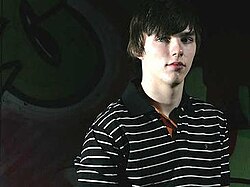
How is Tony Stonem represented


Tony Stonem doesn't follow the generic stereotype of a teenage boy. For example you would imagine a teenage boy to be very lazy and had a dirty room, that doesn't seem to be the case with Tony. When shown his room you see that its very clean, minimalistic and orderly. Tony is also shown to have a routine in which he gets up does basic exercise then stares at the woman across the street.

The first show we see is a close up of Tony's face, the close up shows Tony with a smug look on his face. The close up again shows us that he isn't a generic teenager as he has freely woken up before him alarm compared to what we are normally shown of teenagers, where they wont get up in the morning. The shot then changed into a long shot above Tony in bed.  The shot shows him laying in the middle of of an extremely neat bed with the images of a naked man and woman on them.  Tony is laid in between the two figures, this could purely be a accident or it could be to show that in later episodes Tony struggles with his sexuality.

When the alarm goes off the scene cuts to a close up a stereo which Tony turns ons.  Once the music is on  you see Tony quickly get out of his bed, stretch then start doing exercise. The audience gets to see more of Tony's room, you can see just how empty and lacking in colour his room is. This could be done to show how Tony isn't your normal teenager

Camera shots in this first selection of filming show close and mid shots of Tony working out, as well as a long shot and over the shoulder shot of Tony looking at the Woman across the street. A long shot is shown of Tony's sister Effy when she is walking down the street, up to her house.

Effy is very much a stereotypical teenage in the way that she has gone against her parents and been out. You're led to believe that this is is a common thing as her and Tony have a plan of how to get her into the house without being caught. Tony turns his music up  loud so his dad argues with him so Effy can sneak in. A high angled camera sot when Effy is trying to get Tony's attention outside shows the audience that even though she is shown as rebellious that is she actually weak and vulnerable and relies on her brother.


 The diegetic sound in this clip starts with the Church bells and birds at the beginning of the clip. There is also diegetic sound when Tony plays his sound system so Effy can sneak into the house. How loud the music is could so just how bad the situation would be if he didn't play the music and Effy got caught. Tony's lack of interest when his Dad is shouting at him again shows how this is a reoccurring situation as his Dad shouts 'every fucking morning'

The next scene of Tony is where he is in the bathroom and his Dad is complaining because he to wants to use the bathroom. Tony know how to play situations to his benefit as he climbs out of the bathroom window just so his Dad still has to wait. You learn that Tony may climb out of the window often as when his Dad finds him at the table he tells him that the lock must be messed up again. He is very smug in the way he talks to his Dad as he tells him that the drill is under the sink. Even though Tony doesn't follow the generic teenage stereotype, he does in some sense as he is sneaky and tries to annoy this parents.


Tuesday, 9 October 2012

Teenagers In TV Dramas

Emily Fitch - Skins


This character has a very strained relationship with her parents due to her sexuality. Her mother doesn't approve of her being gay and this leads to tension through out the episodes. Another strain of the parental relationship is the constant comparison to her twin sister. Emily is shown as a rebellious  teenager with some aspects of her personality fitting that of the generic teenage stereotype. For example she is often shown partying, drinking excessive amount of alcohol and taking legal drugs. Emily style could be considered as rock/indie. Occasionally she dresses with some femininity but normally her outfits are slightly more edgier

Bart McQueen - Hollyoaks


This character probably fits the generic stereotype of teenagers the most. His appearance fits the stereotype of teenagers as they are presumed to wear things like tracksuit bottoms and hoodies. He continues to follow stereotype as he doesn't seem to be going very far with his life and doesn't show any aspirations. He doesn’t have much of a relationship with his parents as his mother walked out on him when he was younger and his father worked on a oil rig. The character continues to follow the negative teenage stereotype when he is arrested for growing cannabis in his aunt’s house, where he was currently living. His relationship with different people doesn’t seem very positive as he is seen being punched in the face as he was suspected of starting a fire.
Charlotte Grayson- Revenge


This character is probably the furthest away from the generic stereotype of teenagers. The character comes across as well spoken, with adult like morals instead of the immature attitude thought about teenagers, this could be to do with the social society in which she was brought up. She is shown to have high aspirations for herself that are backed up her parents. The character dresses in expensive clothing which shows her families social ranking. This character's relationship with her parents vary as the storyline progresses. At the beginning she has a seemingly good relationship with the man she presumes to be her father. Her relationship with her mother is a heated one and this only escalates with her finding out her father isn't who she thinks it is. After finding out this information her relationship with her 'farther' also changes. Her behaviour is what you would expect from someone of high class through out most of the episodes the only exception being her dating a boy her mother doesn't approve of.

Sound

Sound motif -
A sound effect or combination of sound effects that are associated with a particular character, setting, situation or idea through the film. An example of a sound motif would be the background music is Jaws that the shark approaches

example of sound motif in jaws (1:35)


Parallel Sound-
When the musical tone matches the action on the screen. This is seen during the below clip from Casino Royale were the background music builds up audience tension during the chase scene.

Casino Royale Parkour Chase (1:36)


Contrapuntal sound-
Sometimes when we are watching a film, we hear sound that doesn’t seem to match what we are seeing. what we see and what we hear do not match. This is called contrapuntal sound ‘Contrapuntal’ means ‘at a counterpoint to’. An example of this is from the film The Birds. The images gives off a sense of tension, but the music is completely childlike & carefree. With the children being the source of the music it increases the tension as they are unaware of the danger. 

The Birds


Direct address -
When a character on screen directly addresses the audience, alternative of a voice over. An example of this is in the BBC show Miranda, she is often seen talking directly to the audience.

Miranda (32 seconds)


Kick Ass


Inspiration
 
 
The inspiration for  Kick Ass came from the 8 part comic book series of the same name, written by Mark Millar and John Romita, Jr. The story of Dave Lizewski, a teenager who sets out to become a real life superhero. His actions are publicised on the Internet and inspire others. He gets caught up with ruthless vigilantes Hit-Girl and Big Daddy who are on a mission to take down the gangster John Genovese.

 
Producers
Matthew Vaughn
Brad Pitt
Kris Thykier
Adam Bohling
Tarquin Pack
David Reid

Director
Matthew Vaughn
 
Screen Play
Matthew Vaughn
Jane Goldman

 Cast
Aaron Taylor Johnson - Dave Lizewski / Kick-Ass. Aaron Taylor Johnson also narrated the film.
Chloe Grace Moretz - Mindy Macready / Hit-Girl
Mark Strong - Frank D'Amico
Nicolas Cage- Damon Macready / Big Daddy
Christopher Mintz Plasse -  Chris D'Amico / Red Mist
 
Development The rights for the movie version of kick ass were sold before the first issue  of the comic book was published. The script for the movie and the comic book were written at the same time. Even though they have slight differences like in the comic book Big Daddy isn't a ex cop like he is in the film, hes an accountant.
 
Development Fiance
Kick ass struggled to get a production company to go along with the script. Most companies wanted to change the level of violence and swearing in the film. Companies doubted that a film with a violent superhero would be successful. In the end Vaughn independently financed the film, a benefit of this was it allowed him to create the film in the way it was originally intended.
 
Pre Production
Vaughn now had the difficult task of finding the perfect cast for Kick Ass. His main problem was finding an actor that would perfectly fit the role of kick ass. Vaughn had cast the other roles but was still looking for someone to play kick ass. His search for the perfect actor took him so long that he nearly had to push the movie back 6 months. Sarah Finn and Lucinda Syson were Vaugh's casting directors, they suggested that he look back over previous actors. Vaughn had previously turned down Aaron Johnson's tape without even viewing it. Vaughn finally watched Johnson's tape and after hearing him read for the first time knew he was the perfect kick ass.
 
Production
The filming for kick ass took place in Toronto Canada. Dip'N' Sip Donuts and Sir Winston Churchill Secondary School are a few places within Canada that are shown. Filming also took place at Elstree Studios in Hertfordshire, England. The film had been independently financed and there was worry about whether or not a distributor would pick it up. The production companies involved in Kick Ass were Marv Films and Plan B Entertainment. The film did get picked up by distributors, Universal Pictures distributed it in the UK and Lionsgate Films in the US

Marketing
Kick Ass used the usual methods of marketing to get publicity for the films release. Posters were used on buses and billboards. Trailers were also shown on TV, in the cinema and on DVDs. There was a lot of marketing for Kick Ass as it was expected to be successful, even in light of the controversy. It could be said that too much of the Kick Ass story line was realised through the trailers, this didn't effect the film when it was realised as it was a huge success. A few issues of the comic book had also been released before the film came out so the audience had the opportunity to read up on the characters before watching the film. Some of the actors along with Matthew Vaughn and others from  the production of Kick Ass went to Comic-con as a way to promote the film, clips of the film were shown and the actors spoke about their role in the film.


An array of different trailers were released in the build up to Kick Ass. These included a teaser trailer, an extended trailer and an international trailer. The trailers sparked the controversy about Chloe Grace Moretz' involvement in the movie, Moretz was only 11 at the time and is shown using explicit language and violence. A later trailer was released showing Moretz saying 'Okay you cunts, let's see what you can do now.' Even with the controversy that surrounded it Kick Ass was a success at the box office with even more sales when it was released on Blu- Ray and DVD


Kick Ass Teaser Trailer
 
Kick Ass Extended Trailer
 
Kick Ass International Trailer
 

Kick Ass Hit Girl Red Band Trailer


The premier for Kick Ass was held in Leicester Square, London. The cast, directors, producers and screenwriters attended as well as special guests. The film was given as budget of $28 million and made a box office total of $96,188,903. Despite having gained controversy for its profanity and violence performed by a child, it was received well by both critics and audiences. The film was released on DVD and Blu- ray on August 3rd 2010, selling 1.4 million copies within the first week (DVD and Blu-ray sales)